Cover more loads.
Protect every margin.
Your disponent sends the order.
Spedanta is the AI agent for managing spot subcontractors in logistics: it publishes and negotiates your loads by email, collects the documents and tracks every shipment to POD, alongside your TMS.
Posts the load, replies to every carrier in real time and negotiates within your price bands, finding the best combination of cost and reliability.
It collects the documents, monitors the shipment and follows it through to POD.
Your disponent reviews the dispatch and sends the order.
Spedanta handles everything else.
One agent, the whole cycle.
Publishing tools stop at the posting. Negotiation tools stop at the handshake. Spedanta keeps going through everything that comes after (documents, tracking, POD) and writes it back where your team already works.
Publish
Posted where the trucks are, cross-border, split by country.
Assign
Every carrier in parallel. Price and reliability decide who gets the load.
Documents
Insurance, licence and bank details collected, checked and filed.
Track
ETA, loading, transit, delivery. Reminders and escalation on silence.
POD
Proof of delivery requested, read, matched to the order and closed.
Getting the price agreed is roughly a third of the work. The rest (the documents, the ETA chasing, the POD) is where the hours go. That's the part Spedanta is built around, without asking you to change the system you run on.
Nobody overpays on purpose.
They just run out of time.
For every spot load, the disponent has to manage several negotiations. At the same time, they're following other loads, handling customer requests and dealing with the day's operational urgencies. When they get back to a carrier contacted a few hours earlier, that truck may already be booked elsewhere. For a team running 250 loads a month, that means over 130 hours spent on negotiations and more than 60 on documents and tracking. The real constraint is time.
Good disponents, unfair race
For every spot load, a disponent runs several negotiations at once. At the same time they're following other loads, handling customer requests and dealing with whatever the day throws at them. By the time they get back to a carrier contacted a few hours earlier, that truck may already be booked elsewhere. Across a desk running 250 loads a month, that's over 130 hours on negotiations alone and more than 60 on documents and tracking: the equivalent of more than one full-time disponent doing nothing else. The real constraint is time.
- One person, one conversation: five carriers are already replying to someone else
- No shared rule, so every load gets negotiated from zero, under pressure
- More loads means more hires. The desk never gets ahead
Four steps. Every one inside your rules.
Carriers never log in to anything. They receive an email and they reply to it, exactly as they do today. The change is entirely on your side of the screen.
More visibility for every load
Spedanta publishes every load and automatically repositions it at regular intervals,
keeping it visible.
It also creates alternative routes covering the countries bordering the loading and
unloading points. A load from Trieste to Wolfsthal, for example, can appear on
Italian and Slovenian lanes at departure, and Austrian and Slovak lanes on arrival.
- Automatic refresh → more visibility
- Alternative routes → more carriers reached
- Carriers already used on the lane → automatic email
- Once the load is assigned, every posting is withdrawn automatically
- Trieste 341xx → Wolfsthal 24xxIT → AT
- Trieste 341xx → Bratislava 8–9xxIT → SK
- Koper / Sežana 6xxx → Wolfsthal 24xxSI → AT
- Koper / Sežana 6xxx → Bratislava 8–9xxSI → SK
The right carrier for every load
Spedanta handles each negotiation separately and analyses the replies while also
factoring in each carrier's reliability history. When it identifies an offer that
matches your criteria, it compares cost and performance to suggest the most
advantageous assignment.
Because the lowest price isn't always the best choice. If a carrier has a weak track
record, Spedanta flags a safer alternative, reducing operational risk.
- Price and reliability → a better-informed choice
- Every price is validated against your margins before it's sent
- Replies adapt to the carrier's own communication style
- Questions on goods, dates and zone → answers consistent with what you allow to be shared
- Every message gets an answer in under 15 seconds
- Once the right carrier is identified, Spedanta closes the deal and ends the other conversations professionally
- Negotiates in more than 10 languages, matching the carrier's own
Every document ready before the load is assigned
Once the terms are agreed, Spedanta requests all the required documentation from the
carrier: CMR insurance, transport licence and bank details. It reads the
attachments, checks expiry dates and completeness, and files everything against the
order and the carrier profile.
If a document is missing or invalid, Spedanta handles the first checks and follow-ups
with the carrier on its own. If the issue isn't resolved, it alerts the disponent.
- Automatic checks → complete and valid documents
- Central archive → everything in the carrier record
- Missing or invalid documents → handled automatically, then flagged
- The order reaches the disponent already assigned, priced and fully documented
Every truck under control. Automatically.
Once the load is assigned, Spedanta follows the shipment by email automatically. It
requests ETAs and updates on loading, transit and unloading at the cadence you set,
reads the carriers' replies and updates the dispoplan directly.
If the ETA changes, Spedanta flags it immediately, giving the disponent the time
needed to update the customer.
- Custom cadence → frequency and number of updates and reminders
- ETAs and updates → requested automatically
- Delays or missing replies → flagged to the disponent with the whole conversation
- Unreadable POD → automatic re-request, then escalation
The right carrier for this lane
is usually already in your database.
Every load you have ever covered left a trace: who ran it, at what price, how fast they answered, whether the POD came back clean. Spedanta keeps that as a working list and uses it before it ever spends a posting on a freight exchange.
Contacted in order of how likely they are to say yes
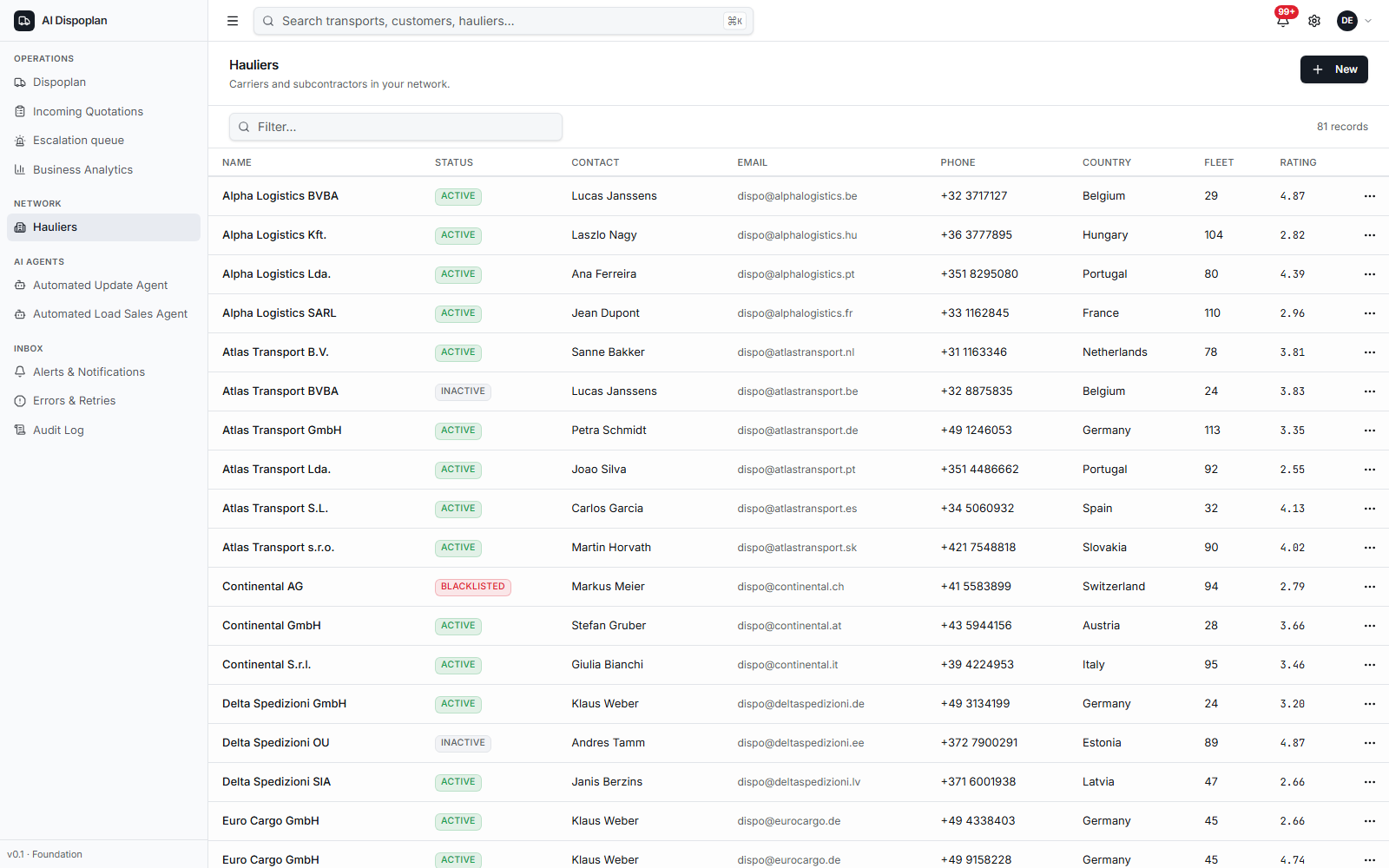
A carrier who has never run Milano–Wien but runs Bergamo–Graz every week is a better bet than a stranger with the exact lane. Spedanta scores corridor overlap and geographic proximity, not just an exact match, so your own hauliers get the first email.
- Lane match from corridor overlap, not exact-lane history alone
- Performance from on-time delivery, reply speed, price level, document reliability
- Every dispatch writes back into the score: the list gets better as you use it
- Your list, your tenant. Never pooled, never used to price another forwarder
Lane match
Corridor overlap and geographic proximity between what the carrier already runs and what you need moved. Adjacent regions count.
Reliability
On-time delivery, how often the POD came back readable first time, how often a booked truck did not show up.
Responsiveness
Average time to first reply. A carrier who answers in twelve minutes is worth contacting before one who answers tomorrow.
Price level
Where their agreed prices sit against your band on comparable lanes, over time, not one lucky quote.
Five sliders.
That is what Spedanta gives you back.
No invented percentages, no case study from a customer you'll never meet. Your volume, your minutes, your hourly cost. The sliders start on the assumptions used above. Disagree with any of them? Drag it and the case moves with you.
FTL spot only. Contracted volume does not count here.
Publishing, calls, counters, closing the deal.
ETA requests, reminders, POD collection and filing.
Gross salary plus employer contributions, divided by worked hours.
Starts at 0: we make no claim here. Move it only if you have your own figure.
per month, on your own inputs, before the subscription
Review time is kept, not removed: the model assumes your disponent still spends 3 minutes per load approving and sending the order. The subscription is priced on volume, so it follows the first slider. We put it against these exact numbers in the call, and say so plainly if it does not clear.
Every load, every thread,
every ETA, alongside your TMS.
The dispoplan is the working view for what Spedanta is running: loads on the left, live carrier conversations behind each one, status and ETA on the right, and the dispatch button that only a person can press. It's not a TMS and doesn't try to be one: your orders stay in the system you already use, and Spedanta reads from it and writes back to it.
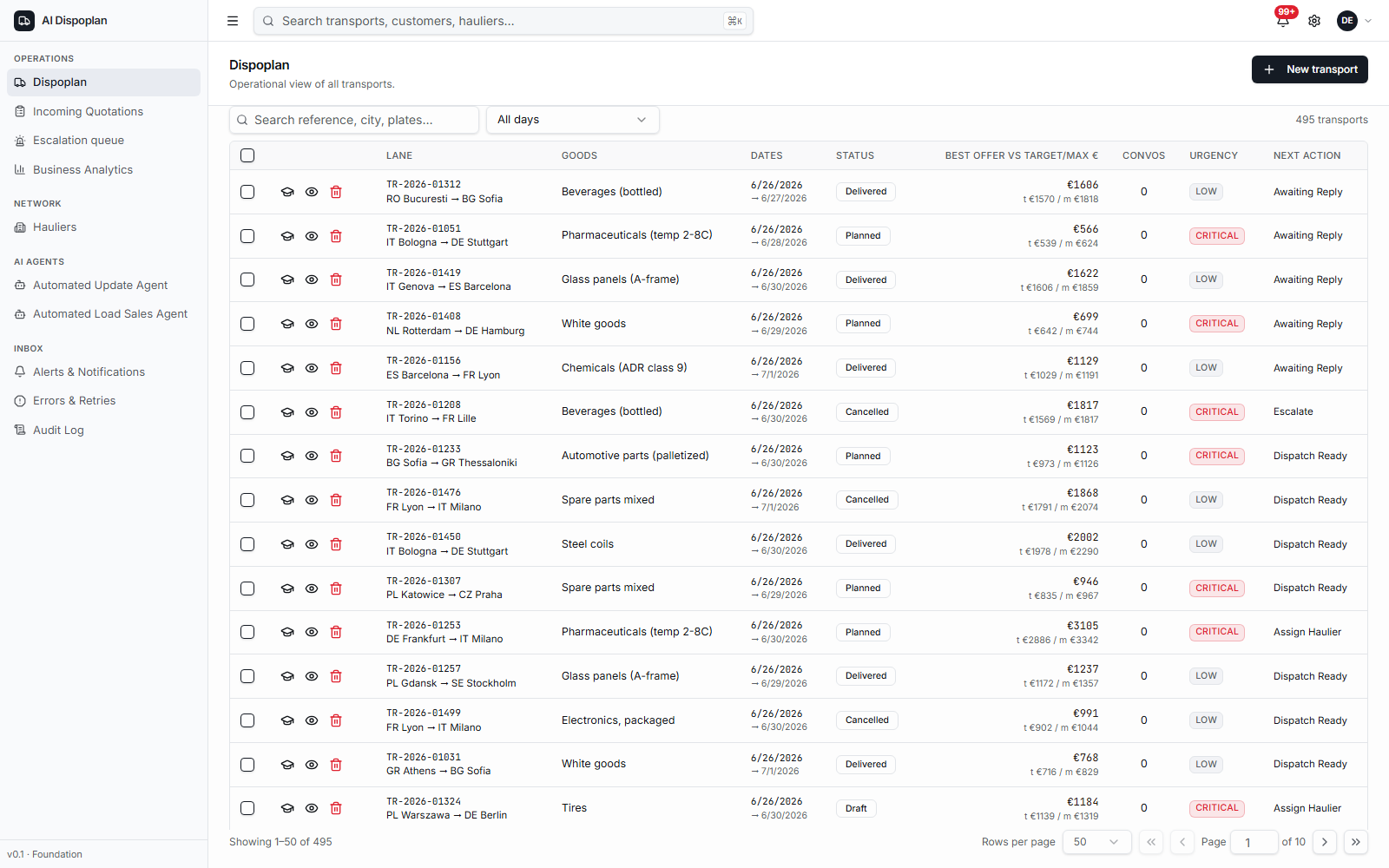
Loads
Straight from your TMS, with the band you set and how many carriers are currently in conversation.
Conversations
Every thread on that load, the current offer on each, and where it sits against your ceiling.
Documents
Insurance, licence and bank details, with expiry dates. Missing anything blocks ready-for-dispatch.
Status & ETA
Loaded, in transit, delivered, POD in. Escalations sit at the top until someone deals with them.
Don't take our word for it.
Read what it actually writes.
A carrier does not care that there is an agent on the other side, and should not be able to tell. Short question, short answer. The number is never improvised. The threads below are illustrative examples, not customer data.
-
Rolla autotrasporti Srl14:021000 minimum. I don't go below that. Truck is already in Milano.
-
Spedanta14:03Understood. On this lane we can do 860 € all-in, payment 30 days.
-
Rolla autotrasporti Srl14:21930 and I close right now.
-
Spedanta14:22880 €. I can't go further than that.
-
Rolla autotrasporti Srl14:40ok 880, send me the order
Pressure does not move the number
"1000 minimum" is a negotiating position, not a market price. Spedanta concedes on a schedule built from urgency, market slack and how close the load date is, not from how firm the other side sounds. Closed 40 € under the ceiling.
start 780 · target 880 · ceiling 920 · closed 880
-
Murol transporte GmbH08:14What goods exactly? And where is the loading point?
-
Spedanta08:15Standard palletised goods, 24 t. Loading in the Milano South area, postcode 20090. The exact address comes with the order.
-
Murol transporte GmbH08:19Side or rear loading?
-
Spedanta08:19Side. 13.6 m tautliner, no tail lift needed.
It answers, up to the line you drew
You decide, field by field, at which of the six stages each piece of load information may leave the building. Goods type and zone are released on the first email; the exact address only once the order is sent. The agent cannot skip a stage.
16 fields · 6 stages · set once, applied to every load
-
Pavel transport SP Z.o.o.11:301050 EUR. Final price, diesel is diesel.
-
Spedanta11:31Understood. Our limit on this lane is 920 €. If that works I can confirm now.
-
Pavel transport SP Z.o.o.11:44no. 1050
-
Spedanta11:44Then we'll leave this one. Thanks for the quick answer. I'll come back on the next Wien load.
-
Conversation closed at ceiling. Carrier kept in the pool for this lane. No offer above 920 € was ever generated.
The ceiling is enforced in code, not in a prompt
Every outgoing message passes a deterministic check before it leaves. A number above your maximum is rejected at send and the turn is re-planned. There is no phrasing, no urgency and no carrier that can get around it.
hard rail · rejected at send · logged
-
Spedanta06:00Good morning, ETA for Wien 1230 today? Load IT-AT-4471.
-
Spedanta · reminder 108:30Following up on today's ETA for Wien.
-
Spedanta · reminder 210:15Still no ETA for IT-AT-4471, can you confirm the truck is on the way?
-
11:04 · ESCALATED TO DISPONENT · carrier silent 5 h 04 on an active load. Thread, phone number and last known position attached.
Silence is an event, not an absence
The agent does not wait for someone to notice. Missing replies, a slipping ETA, a load not picked up, an unreadable POD: each has a reminder count and an escalation rule, and each lands on the right disponent with the whole thread attached.
you set the ETA hour · you set the reminder count
-
Spedanta07:30Morning, ETA to loading in Milano 20090 today? Pickup window closes 12:30. Load IT-AT-4471.
-
Chorinopoulos transport SA09:12Problem, truck stuck on the A4, accident. Earliest at your ramp 16:30.
-
09:12 · ETA TO PICKUP 16:30 · window closes 12:30 · MISSED BY 4 h
-
09:12 · ESCALATED TO DISPONENT · carrier misses the Milano pickup window. Full thread and last position attached.
-
09:13 · Load IT-AT-4471 re-published on 3 Freight exchanges · 6 carriers in range notified · replacement offers gathering for the disponent to choose
A missed pickup, caught at 09:12, not 12:31
The loading window closes at 12:30. The carrier says 16:30. The agent doesn't wait to find out at the ramp: the moment the ETA blows the window it flags your disponent and reposts the load on Freight exchanges, so replacement trucks are already lining up while there is still time to save the slot.
The reposting is automatic; choosing the replacement and sending the order stays with your disponent. The agent buys the hours, the human makes the call.
window 12:30 · ETA 16:30 · reposted 09:13 · replacements incoming
Four things it will never do to you.
Handing negotiation to software is only sane if the limits are structural. These four are not settings. They are how the system is built.
Improvises a price
The AI reads the negotiation, chooses the strategy and decides when to hold and when to concede. What it can't do is go outside the limits you set: every number it puts on the table is validated against your margins before it leaves.
Sends the order
The agent's role has no dispatch permission. The state machine will not advance past "ready for dispatch" without a human. This is enforced in access control, not by instruction.
Reveals sensitive information
Sixteen load fields, six disclosure stages, configured once by you. A carrier who has not been assigned the load cannot get the address out of the agent by asking nicely.
Leaves the EU
Models and data hosted in the EU, immutable audit log of every offer, message and rationale, GDPR and EU AI Act by design. Your carrier list stays yours.
Priced on your volume.
Never on your freight spend.
A flat monthly fee with a load allowance included, and a fixed rate per load above it. No per-seat licences, no percentage of what you pay your carriers, no charge for the conversations the agent has. Twelve-month contract, billed quarterly in advance.
Up to 50 loads a month
- Negotiation and tracking
- Load-board publishing
- Document collection
- One team
Up to 100 loads a month
- Everything in Starter
- Carrier database & lane scoring
- Multiple teams and disponents
- Full audit export
Up to 250 loads a month
- Everything in Business
- TMS integration
- Per-team price bands and strategies
- Priority support
From 500 loads a month
- Everything in Growth
- Dedicated onboarding manager
- Custom escalation and SLA
- Volume rate above the allowance
Beta this September.
Commercial launch in January.
We are not going to pretend this is a five-year-old product. It is not. Here is our current plan and exactly where the product stands today, so you can judge for yourself whether the timing works for you.
Negotiation and tracking, end to end, with the first group of forwarders.
Running on real spot loads. Bands, tone and escalation tuned on live outcomes.
Audit, compliance, SLA and billing. Release-readiness gate.
Generally available on annual contracts. Onboarding opens.
Transporeon API: automatic slot booking and real-time updates sent to your customers.
Have another process you'd like automated? We're always available to build new agentic solutions for our clients.
Your lanes set the defaults
We have no pilot forwarder yet, which means the first ones in decide what "normal" looks like: concession pace, disclosure stages, escalation thresholds.
Founding terms, kept
Your first annual contract is priced at pilot terms and stays there on renewal. No retroactive repricing when the list price moves.
You talk to the builders
Two founders, one of them full-time technical. No ticket queue between your disponent and the person who writes the code.
The questions every forwarder asks first.
Do carriers need to install anything?
No. Carriers reply to a plain email from your domain, same as today. There's no portal to log into and no app for hauliers to adopt.
Can the AI send an order without me?
No. The AI drafts and negotiates within the margin band you set. You choose whether your team reviews and confirms every order before it goes out, or whether the AI can send it on its own within those limits.
What happens if a carrier reply falls outside the negotiation?
Anything unusual (a missing document, an out-of-band question, a reply that doesn't fit the script) routes straight to the escalation queue for a person to handle.
How is our carrier and negotiation data handled?
Every message and offer is recorded in a searchable audit log tied to your account. Nothing is shared across customers or used to price someone else's freight.
How much setup does this take?
There's no carrier onboarding and no new software to roll out. Email and Freight exchanges publishing work the way your desk already uses them. Most of the setup is agreeing on your margin bands and escalation rules.
What does it cost?
Pricing depends on your load volume and carrier network, so we don't publish a flat number. Book a call and we'll walk through it against your real numbers.
Send us one lane.
We'll show you how Spedanta would run it.
Reply to the email or message you received this page with, one lane is enough to start. We'll come back with how Spedanta would handle it on your numbers, and say plainly if it doesn't add up at your volume.